

Estimated reading time: 10-12 minutes
What You Will Learn
- Why a stalled therapy session should be explored rather than automatically labeled as resistance.
- How brief visual methods can change the form of therapeutic exploration when conversation feels repetitive.
- Ten practical art-based techniques for moments when words are not moving the work forward.
- How brief creative interventions can complement CBT, TEAM-CBT, ACT, psychodynamic, and integrative work.
- Why professional art therapy is different from simply introducing drawing into psychotherapy.
- How to process imagery without assigning meanings the client has not identified.
- When changing the therapeutic method may help, and when the relationship itself needs attention first.
When Talk Therapy Stalls

Most therapists eventually encounter a session in which the conversation seems to stop moving. A client may answer repeatedly with “I don't know,” describe the same situation without discovering anything new, understand a cognitive pattern intellectually while remaining unsure what to do differently, or simply become quieter and less engaged. It is tempting to assume that something inside the client is blocking treatment, but a stalled session can have many explanations. The client may be tired, uncertain about what the therapist is asking, ambivalent about change, uncomfortable with the direction of the session, afraid of judgment, unable to identify a feeling yet, or experiencing a strain in the therapeutic relationship. Sometimes the therapist's chosen intervention is simply not helping.
That distinction matters clinically. Contemporary psychotherapy research treats alliance ruptures as meaningful moments in treatment rather than mere client opposition. A rupture can involve disagreement about goals, reduced collaboration around therapeutic tasks, or strain in the relational bond. A meta-analysis of 11 studies involving 1,314 patients found a moderate association between successful rupture resolution and better treatment outcomes. A 2026 systematic review likewise found that ruptures can threaten trust and hope, but that their repair may strengthen shared understanding and contribute to therapeutic change. Before introducing any technique, therefore, it can be useful to ask a simpler question: Are we stuck because another mode of exploration might help, or is the stuckness itself something we need to talk about?
Brief visual interventions can be useful when the first possibility seems more likely. Moving from conversation to drawing, mapping, shape, or color changes the task without requiring the client to disclose more than they want to. The purpose is not to bypass resistance or gain access to material the client is withholding. It is to offer another representational format that may help both therapist and client look at the same experience differently.
Professional terminology also matters here. The American Art Therapy Association defines art therapy as a mental health profession integrating active art-making, creative process, psychological theory, and human experience within a psychotherapeutic relationship. Professional art therapists have master's-level or higher specialized training. Therapists from other disciplines may use art-based exercises within their own competence and scope, but introducing a drawing exercise does not by itself constitute professional art therapy.
Why Changing the Medium Can Help
When therapy becomes repetitive, changing the form of the task can alter what receives attention. A client who has explained a conflict verbally many times might notice something different when asked to draw the competing positions on opposite sides of a page. Someone who cannot immediately name an emotion may be able to indicate that it feels dense, small, sharp, scattered, or far away. A client who understands a CBT cycle intellectually may see something new when the sequence is mapped visually.
This does not happen because art switches therapy from the logical left hemisphere to an emotional right hemisphere. The popular idea that artistic and intuitive functioning belongs primarily to a “creative right brain” is an oversimplification. Art-making, creativity, emotion, memory, language, and visual processing involve interacting networks across both hemispheres, and reviews of creativity research have specifically challenged the idea that creative functioning belongs to one side of the brain.
The evidence for professional visual art therapy is encouraging but also broader than these individual techniques. A 2026 meta-analysis of 12 randomized controlled trials involving 741 adults found improvements in depressive and anxiety symptoms associated with visual art therapy. A larger 2025 meta-analysis examining anxiety included 35 randomized trials and 3,167 adults and also found favorable effects, although the authors graded the overall evidence as very low quality because of considerable heterogeneity and other limitations. Those findings support continued use and study of visual art therapy. They do not establish that a one-minute scribble or body map is independently validated as a treatment.
Introducing an Art-Based Exercise Without Creating More Resistance
Adults who are comfortable talking may suddenly become apprehensive when paper and markers appear. “I'm terrible at drawing” can quickly replace “I don't know.” The way an exercise is introduced therefore matters. Rather than announcing that art will access deeper material, frame it as an experiment: “We've been looking at this verbally for a while. Would you be willing to try putting it on paper for a few minutes and see whether anything looks different?” Make it explicit that artistic ability is irrelevant, participation is optional, and the client can return to conversation whenever they want.
This is particularly important when the therapy is already strained. Offering an unexpected creative technique as a solution to the client's supposed resistance can deepen the rupture. Collaboration comes first. Sometimes the most productive response to “I don't know” is not a new intervention at all, but curiosity about what it feels like to be asked the question.
1. The Emotion Shape
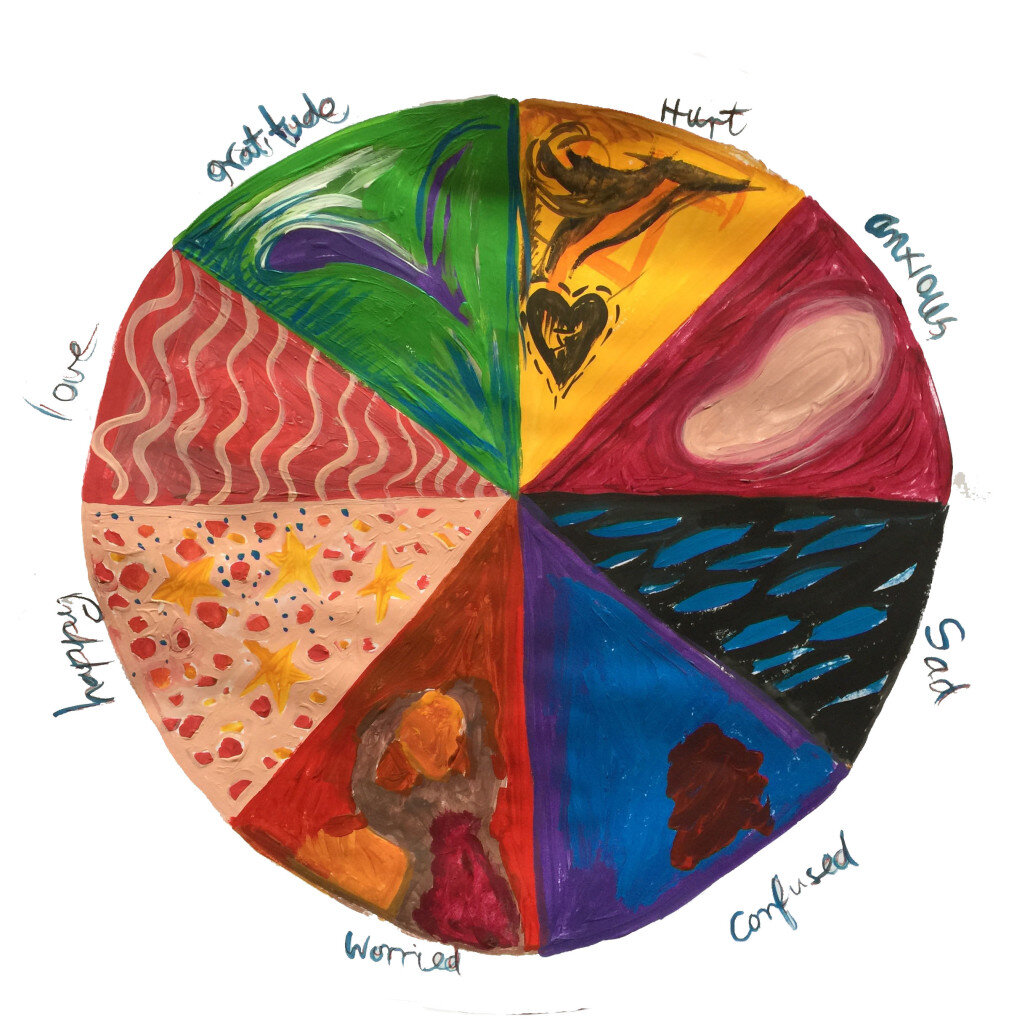
Invite the client to represent the current emotional experience using shape, color, line, texture, or some combination of them, without requiring an emotion label first. A person may draw something compressed in one corner, cover the page in rapid lines, or produce a nearly empty image. None of these choices has an established diagnostic meaning. The value of the exercise is that it gives therapist and client something concrete to observe together. Ask “What do you notice first?”, “What was it like making this?”, or “Does any word fit the experience better now than it did before?” For a client who has been searching unsuccessfully for the correct emotion word, starting visually may create a different route into description.
2. The Inside and Outside Image
Divide a page into two spaces and invite the client to represent what is visible to other people in one area and what is less visible in the other. This can be useful when therapy has reached questions of emotional masking, self-presentation, boundaries, or differences between private experience and public behavior. Avoid assuming that the outside image is false and the inside image is more authentic. People adapt how much they reveal according to context, and privacy can be healthy. More useful questions include “Who gets to see each side?”, “What influences what you show?”, and “Is there anything you wish were easier to communicate?”
3. The Stuck Loop Map
For clients already working within CBT, map a recurring sequence visually: situation, interpretation, emotion, physical response, behavior, and consequence. The client can use arrows, colors, images, or words and can add feedback loops showing how one consequence becomes the next trigger. The benefit is not that visual mapping automatically restores agency, but that relationships among elements can become easier to examine when they occupy the same page. Ask “Where does the cycle seem easiest to interrupt?” or “Which arrow are we least certain about?” This can be especially useful when a client understands CBT terminology but the formulation has become too abstract.
4. Two Voices on One Page
Invite the client to represent two positions involved in an ambivalent decision. One might want change while another is cautious about it. They can be represented through drawings, speech bubbles, colors, symbols, or simple written statements. Within TEAM-CBT, this can complement exploration of outcome resistance, the model's term for understandable reasons a client may feel ambivalent about reaching the stated therapeutic outcome. TEAM-CBT approaches this ambivalence by identifying the values, advantages, or protective functions associated with the current problem rather than immediately arguing against them.
The drawing should not be used to prove that a client unconsciously wants to stay unwell. Instead, it can make competing priorities easier to discuss. Ask “What is each side trying to protect?” and “What would each side be worried about if the other completely won?”
5. Scribble and Respond
Ask the client to make an unplanned scribble for 20 or 30 seconds, then pause and look at it. They may rotate the page, identify a shape, add something, or simply respond verbally. A prompt such as “If anything about this catches your attention, what is it?” is preferable to insisting that the scribble contains hidden meaning. This is a low-demand activity for clients who become perfectionistic when asked to draw something recognizable. It can introduce spontaneity without turning spontaneity into evidence of unconscious disclosure.
6. The Container Drawing
Invite the client to imagine and draw a container that could hold a feeling, thought, worry, or unfinished issue temporarily. The client determines what the container looks like, whether it opens, what stays outside it, and whether anything goes into it at all. The exercise can be useful near the end of a session when emotionally significant material cannot be explored fully, but it should not be described as automatically regulating emotional flooding. A drawing cannot literally contain distress. Its value is symbolic and organizational, and some clients may find the idea useful while others do not.
7. The Present and One-Step-Forward Images
Instead of asking for dramatic “before” and “after” pictures, invite the client to draw the present situation and then represent what one realistic shift might look like. The second image does not need to show happiness or recovery. It might simply contain slightly more space, one additional option, another person, or a different relationship to the problem. This can be useful when large treatment goals feel abstract or when the client says they want change but cannot imagine what change would actually mean in daily life. Discussion can focus on “What became different?” and “What would have to happen for that small change to become possible?”
8. The Body Sensation Map
Provide a simple body outline and invite the client to indicate sensations associated with the topic being discussed, such as pressure, heat, numbness, tightness, movement, heaviness, or ease. The exercise can support interoceptive attention, but the therapist should not infer that an emotion or trauma is literally stored in the marked body area. It is also important to recognize that body-focused attention can increase distress for some clients, including people with trauma histories, dissociation, chronic pain, or health anxiety. Ask permission before shifting attention inward and allow the client to stop or focus only on neutral areas.
9. Give the Image a Title
After almost any creative exercise, ask whether the client wants to give the piece a title. The title can be descriptive, humorous, ambiguous, or left blank. This very small addition sometimes helps someone move from making an image to reflecting on what stands out about it. A title such as “Keeping Everything Together,” “Not Yet,” or “Too Many Doors” may create a useful opening, but the therapist should not treat the title as the definitive interpretation of the artwork. A good follow-up question is simply: “What made that title fit?”
10. The One-Minute Image
Set a timer for one minute and invite the client to make marks continuously or create a quick visual response to a question such as “What feels most important right now?” Time limits can reduce the pressure to create a polished image, but they are not universally helpful. Clients with performance anxiety may experience a timer as another demand. Offer it as an experiment and remove the time limit if it increases tension. The therapeutic aim is flexibility, not forcing spontaneity.
Processing the Artwork Without Turning It Into a Test
The client should remain the primary interpreter of what they create. Therapists can observe visible features, ask questions, and connect the activity with the larger treatment formulation, but visual elements should not be assigned universal meanings. Statements such as “red means anger,” “a small figure shows low self-esteem,” or “the closed box represents repression” transform collaborative reflection into speculative interpretation.
Useful questions are simpler: “What stands out to you?” “What surprised you?” “Was anything different from what you expected?” “What does this part mean to you?” “Does this change anything about how you understand the problem?” Sometimes the client will discover a meaningful connection. Sometimes the exercise will confirm what was already known. Sometimes it will lead nowhere. None of those outcomes needs to be framed as success or failure.
Emotional intensity is also not evidence that an intervention has worked. Tears, silence, a sudden memory, or a strong bodily response require the same clinical judgment as they would during verbal therapy. The therapist's task is not to extract insight from every image but to determine whether the process remains useful, consensual, and connected to the client's goals.
Art-Based Techniques Across Therapeutic Models
These exercises can complement several therapeutic approaches when adapted carefully. In CBT, visual mapping can clarify relationships among situations, cognitions, emotions, physical sensations, and behaviors. In TEAM-CBT, visual dialogue can help make ambivalence about goals or methods more discussable, but it should supplement rather than replace collaborative assessment of resistance. In ACT, imagery may support values clarification, perspective-taking, or cognitive defusion when used consistently with the model. Psychodynamic or relational therapies may use visual work as another source of association and reflection, but imagery should not be treated as direct evidence of unconscious content.
Trauma-focused therapy requires particular caution. A 2024 meta-analysis of 21 randomized trials involving 868 participants found promising effects of visual arts therapies on some outcomes following trauma, but results for PTSD-specific symptoms were mixed. Creative expression is therefore not automatically a safer or gentler route into traumatic material. Images can evoke intense experiences just as words can, and clients should retain control over what they create, how closely they approach traumatic content, and whether the artwork is discussed afterward.
When the Stuckness Needs Conversation, Not Another Technique
A creative exercise should not become a way for the therapist to escape a difficult therapeutic moment. If the client has become disengaged because they feel misunderstood, pressured, judged, or uncertain about treatment, changing to markers and paper will not repair the underlying problem. In those situations, naming what is happening may be more useful: “I have a sense that we're working hard but not really getting anywhere together. How is this conversation feeling from your side?”
This is one reason the research on alliance rupture is so relevant to stalled therapy. Rupture repair involves recognizing tension, inviting the client's perspective, exploring disagreements about goals or tasks, and restoring collaboration. Research suggests that successful repair is associated with better treatment outcomes. A therapist who treats every moment of hesitation as resistance risks missing information about the therapy itself.
Brief art-based interventions are most useful when they expand the work rather than push it forward against the client's wishes. A shape can provide a new way to describe an emotion. A loop can make a cognitive pattern easier to see. Two voices can help ambivalence become discussable. A body map can turn a vague statement such as “I just feel it” into more specific observation. These are shifts in perspective, not shortcuts to hidden truth.
Conclusion: When Words Stall, Change the Question Before You Push for an Answer

A stalled therapy session is not necessarily a dead end, and it is not automatically evidence that a client is resistant to treatment. Sometimes the conversation has become overly familiar. Sometimes the client has not yet found language for an experience. Sometimes there is genuine ambivalence about change. At other times, the therapeutic relationship or the current treatment strategy needs attention. The first task is therefore not to defeat the stuckness but to become curious about it.
Brief visual techniques can be useful because they change how the problem is represented. They can move an issue from conversation onto a page, make competing positions visible at once, or create enough structure to notice something that had remained vague. Current evidence supports professional visual art therapy as a promising adjunctive intervention for several psychological outcomes, while also reminding us that the research is heterogeneous and does not validate every brief drawing prompt as an independent treatment.
The most skillful use of these exercises is therefore modest and collaborative. Offer them rather than prescribe them. Observe rather than decode. Return meaning to the client. And remain willing to abandon the technique if the real therapeutic task is happening somewhere else.
When words stop moving, an image may open another route. Sometimes, however, the most important intervention is asking together why the conversation stopped in the first place.
References
American Art Therapy Association. (2026). About Art Therapy.
Burns, D. D. (2020). Feeling Great: The Revolutionary New Treatment for Depression and Anxiety. PESI Publishing.
Guo, Z., Liu, Y., Zhu, S., & He, Y. (2026). Effects of visual art therapy on depressive symptoms in adults: A systematic review and meta-analysis. Frontiers in Psychiatry, 17, 1877502.
Huang, W., et al. (2025). The effects of visual art therapy on improving anxiety symptoms in adults: A systematic review and meta-analysis. Journal of Psychiatric and Mental Health Nursing, 32(5), 1197–1210.
Maddox, G. A., Bodner, G. E., Christian, M. W., & Williamson, P. (2024). On the effectiveness of visual arts therapy for traumatic experiences: A systematic review and meta-analysis. Clinical Psychology & Psychotherapy, 31(4), e3041.
Margetts, E., Elahi, A., & Bowe, J. (2026). A systematic review and thematic synthesis of qualitative literature on the experiences of alliance ruptures within psychotherapy. British Journal of Clinical Psychology.
Malchiodi, C. A. (Ed.). (2012). Handbook of Art Therapy (2nd ed.). Guilford Press.
Safran, J. D., Muran, J. C., & Eubanks-Carter, C. (2018). Alliance rupture repair: A meta-analysis. Psychotherapy, 55(4), 508–519.


